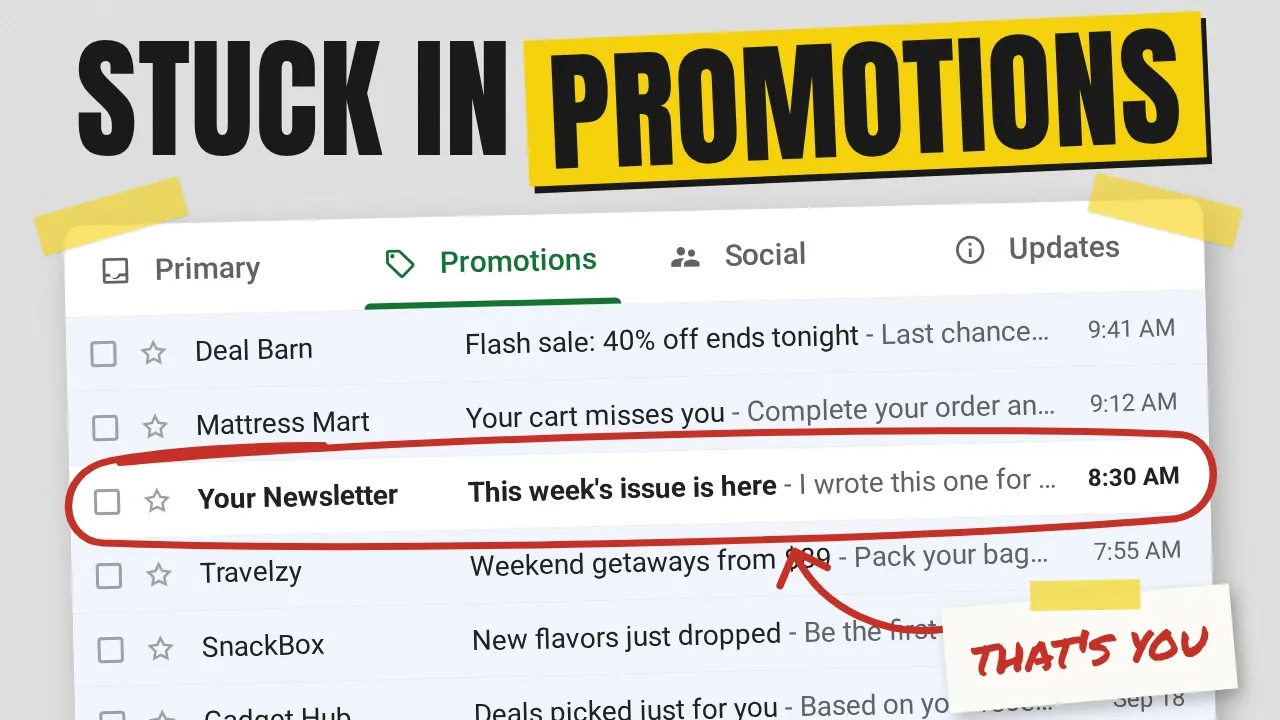
Email deliverability for beginners, explained with Saturday morning cartoons
How to get your newsletter into the inbox more often: cadence, engagement signals, list cleaning, the right subscribers, and a fun welcome sequence.
12 min read
If you're new to email, or you're somewhere between beginner and intermediate, this one's for you.
This is for people who want to improve their email deliverability but already have all of their deliverability settings set up. You're not looking for help with compliance. You just need help getting placed in your reader's inbox more often.
So I'm going to break it down in a way that makes sense, in a way that's relatable, and in a way that's fun. We're going to look at deliverability through the framework of Saturday morning cartoons. If you grew up around the TV watching Saturday morning cartoons, this is going to be so simple for you to understand.
The short version
Show up every Saturday morning. Send on a consistent cadence, at the same time, about the same subject.
Watch your ratings. Opens, clicks, and replies tell Gmail, Yahoo, and Apple Mail whether people want your emails. Clicks and replies count most.
Cancel the shows nobody is watching. Remove subscribers who haven't opened, clicked, or replied in 90 days.
Air on the right channel. Attract subscribers who actually fit your newsletter, and make your landing page crystal clear.
Give them the binge. Make your welcome sequence fun, because new subscribers are never more engaged than in their first days.
1. Cadence: show up every Saturday morning
Why are Saturday morning cartoons the perfect framework for email deliverability? It's a lot simpler than you think.
You would show up every Saturday morning to watch cartoons. It's right there in the name. Every Saturday morning there would be cartoons on the TV. You knew that for a fact.
And the number one most important thing for newsletter deliverability is cadence. It's really, really, really important.
Send your newsletter on a regular cadence, at the same time, about the same subject. It doesn't have to be the exact same time. "Saturday morning" is a framework of a time, right? But if you send that weekly or biweekly email on Monday, and Monday, and Monday, it's a lot easier for Google to identify your habits, and a lot easier for people to know what to expect from you and when to expect it.
That helps you get more opens, more clicks, and more replies.
Consistency and cadence are important to everything in email. When you stop talking for a little bit, then send a bunch, then stop talking, then send a bunch, it basically reads to email providers like Google and Yahoo that you are love bombing the people on your newsletter.
2. Engagement signals: know what keeps the show on the air
The next thing you need to understand is what keeps the show on the air. For you, that means what keeps your newsletter running, healthy, and in people's inboxes.
For a cartoon, it's people watching the show, people recommending the show, and people reviewing the show. All of these things keep a show on the air longer.
Maybe I'm pulling the curtain back for some of you here, but Cartoon Network knows how many people are watching its shows. And outside of Cartoon Network, there's a company that does ratings. It's called Nielsen. There are Nielsen households out there pressing a button on their little remote that says, "Hey, I'm really watching this show." The more watch hours a show gets, the more it tells Nielsen that it's a popular show. Each of those households stands in for thousands of others, so that button is a real indicator of whether people are watching a show and whether they like it.
You can take it a step further. Saturday morning cartoons (and the Sunday funnies) used to have a mail-off section. There was always a section that let you reply, that let you engage with it a little bit. Even now you can post about a cartoon on social media, go review it somewhere, or literally give it a score on iTunes.
These are all ways the network understands what's working and what isn't. And that's what directly influences how long a cartoon stays on the air.
The same thing applies to your newsletter. What tells you if your newsletter is or isn't working is your opens, your clicks, and your replies. These are the three things Google uses, and the three things you should be using, to know if your emails are resonating with people.
When people open, click, and reply, it tells Google, Yahoo, and Apple Mail that this isn't a promotional email. It's something that happens regularly. It's something people are looking for.
Why your open rate isn't reliable anymore
When you're looking at your open rate, remember that Apple automatically opens every single email to protect its users' privacy. So your open rate isn't as reliable as it used to be.
It's like the people in the TV world who could leave Saturday morning cartoons on for their cat while they're out at brunch, enjoying their Saturday, doing their own thing. The TV is on. Nobody's watching.
That makes replies and clicks more important than they've ever been.
If the opens are the eyes, the replies and clicks are the avid watchers. They're the people talking about the cartoons, watching with their friends, sending off the Sunday funnies mail-off to collect their freebies. Those are the real performance indicators.
One reply won't fix your whole list
Just because one person replies to your email doesn't mean your email is more likely to be delivered to every person on the list. What it does mean is that your email is more likely to end up in the Primary inbox for anyone who has ever replied.
So if I reply to your email and say, "Oh my gosh, I loved what you talked about," and you say, "Thank you so much, Caleb, I really appreciate you reading this," the next time you send me a newsletter, Google is more likely to put it in my Primary inbox. It assumes we have a personal connection.
But say you send that same email to Sally down the way. She's on Gmail too, and she lives one house over from me. Google doesn't know if Sally has a personal connection with you, so it's going to assume she doesn't. It's going to look at her actions and her behaviors to figure out whether she does. Maybe she doesn't.
That's why replies are so important.
3. List cleaning: cancel the shows nobody is watching
Opens, clicks, and replies are all indicators that people are paying attention. And that funnels into the one thing that can help your deliverability more than anything else on your list.
Most people don't do this. I'm working with a client right now who hasn't done it in over five years. We're about to do it for the first time ever, and it's going to drastically improve their deliverability.
It's list cleaning.
Every inactive subscriber costs you twice
Every person on your list who isn't opening and isn't engaging with your emails costs you money. It might not be a lot of money. It might barely be any money to you at all. But it costs you in two ways:
On most ESPs, you pay per subscriber. Whether it's 10 cents or a tenth of a cent, it doesn't matter. You still pay for every subscriber on your list.
When your deliverability is low for one person, it's low for every person.
It's recommended by email professionals (that's me) and backed by data that when you remove people who aren't engaging with your emails, your overall deliverability improves. I'm pretty sure the research I read said around 20%.
That would be huge. Imagine your next launch going from 100 people hearing about the product you're selling to 120 people hearing about it. Say 10% of them buy. That's 12 customers instead of 10. Two additional customers, just from cleaning your list. Depending on how much the product costs, that could be $2,000. That could be rent.
I'm just saying. Don't shoot the messenger.
How to clean your email list
It's really important to do this regularly. Every three months, every four months, once a quarter. What you're looking for are people who haven't opened, clicked, or replied to an email in 90 to 180 days.
The shortest I'd let someone go without responding is 90 days. Anything over that, you do not make the cut. You are not moving on to the next round. You are not America's Next Top Model.
You can do this one of two ways:
Just remove them. That's what I suggest.
Send them a re-engagement email that says, "Hey, it looks like you haven't engaged. Could you reply or click this button to let me know you want to stay on this list?" This matters more if some of your subscribers use email setups that don't show clicks or tracking.
In all my personal and professional experience: just remove them. They're not going to notice. The number of people you'll save is very marginal, and in my opinion you end up with more unsubscribes and potential complaints from those emails. The juice ain't worth the squeeze. Just prune the people and keep it pushing.
Once you do that, your list is clean, and you don't have to think about it for the next 90-ish days.
And you're not tracking all of this on your own. You're not making a little tally mark every time you send an email. Almost every email service provider, whether it's Kit, ActiveCampaign, Flodesk, Substack, or whatever, has a way to find inactive subscribers built in.
4. Subscriber quality: not every channel has Saturday morning cartoons
I know. I know. I know.
What this actually means for your newsletter is that you need to be marketing it to the right people. If you're getting low quality people on your list (and I'm not talking about who they are as a person, I'm talking about how they fit your newsletter), there are a few things you can do.
Recommendation networks
The recommendation networks on Substack, Kit, and beehiiv all have a tendency to bring in low quality leads. To prevent that, set up a specific welcome sequence just for those people. Or, if you don't know how to do that, turn the feature off.
What I've found is that when you don't set up a specialized welcome sequence for them, recommendation subscribers tend to mark your content as spam. They don't know why they're getting your emails. They didn't intentionally sign up, or your emails aren't a good fit for them, and they're not sure how they got there. They don't remember. We click a lot of buttons on our computers every day.
It matters to me that the people finding your list are high quality leads, because those are the people opening it. And that's what keeps you in the inbox.
Not every channel shows Saturday morning cartoons, which means not every person watching TV on Saturday morning wants to see your cartoon. And that's okay. It's a blessing to not be everybody's cup of tea.
Freebie swaps and collabs
If you're growing your list by going on podcasts, posting lead magnets on social media, or collabing with people, by all means, please do that. But remember that it's important to be aligned with the people you're collaborating with. When you choose them, you're also choosing their audience. If that audience isn't aligned with what you share in your newsletter, they probably won't stick around long, and they won't open your emails.
Your landing page
Finally, finally, finally: make sure your landing page is super, super, super clear. If it doesn't say you're sending cartoons every Saturday morning, then people show up, get cartoons every Saturday morning, and go, "Why the hell am I getting cartoons every Saturday morning? I don't want to read this."
Clarity is important here.
5. Your welcome sequence: give them the binge
This next one is dead simple, and it comes straight from my Dopamail framework.
Make your emails fun.
When you have fun with your subscribers, they're more likely to engage. It releases a little happy brain chemical, and the next time they see you in their inbox, they think, "Oh my gosh, that person gave me a little bit of dopamine. I'm going back in." It was fun, so they engage again, and then it comes back around. It's addicting.
And start this early, with your welcome sequence. Statistically speaking (not my personal opinion, statisticians, people smarter than me), people are never going to be as engaged as they are in the first nine days after they subscribe to your newsletter.
So if you're going to use Dopamail, where engaging is fun and it creates a cycle, it's really important that you start embedding it as early as possible. It sets a baseline for exactly what they're going to get from every email you send, forever.
Let's call this the binge. The binge of your Saturday morning cartoon. It should give them the very best dopamine hit on that first day, so they're ready to see your name in the inbox over and over and over again. So they sit down in front of that TV set every Saturday morning, eagerly awaiting your cartoons.
Dopamail embedded into your welcome sequence is what moves people from showing up in front of their TV and choosing Saturday morning cartoons, to sitting in front of the TV eagerly waiting for their Saturday morning cartoons to start.
Those are two different people. We want to get from one to the other. And it starts with the welcome sequence, along with everything else we just talked about.
Email deliverability FAQ
How often should I send my newsletter for good deliverability?
Whatever you can keep up consistently: daily, weekly, or every other week. The frequency matters less than the pattern. Send at about the same time, about the same subject, so both your readers and Google learn when to expect you. Going quiet and then sending a burst is what hurts.
Why is my open rate so high but nobody clicks?
Apple Mail automatically opens emails to protect its users' privacy, so a chunk of your opens are the TV playing to the cat. Track clicks and replies instead.
Do replies really help deliverability?
Yes, for the person who replies. When someone replies to your newsletter, Gmail is more likely to put your future emails in their Primary inbox. It doesn't boost placement for the rest of your list, which is why you want lots of people replying.
How often should I clean my email list?
Once a quarter. Remove anyone who hasn't opened, clicked, or replied in 90 days (180 at the very most).
Should I send a re-engagement email before removing inactive subscribers?
You can, but I don't recommend it. You save very few people, and those emails tend to bring more unsubscribes and spam complaints. Just remove them.
Can recommendation networks hurt my deliverability?
They can. Subscribers from recommendation networks often don't remember signing up and mark you as spam. Give them their own welcome sequence, or turn recommendations off.
Keep the show on the air
Does this framework make sense? I felt like it was an easier way for people who are new to understand deliverability, and a lot more fun than "you have to do this to do this."
If you want more frameworks like this, I send a newsletter. Get it here. And if you want me to look at your deliverability, your welcome sequence, or your whole email setup, book a call.
Dopamail is a method I created at Actually Fun Email. It is a method for building dopamine feedback loops into email, so subscribers get rewarded for engaging and start prioritizing your newsletter.